
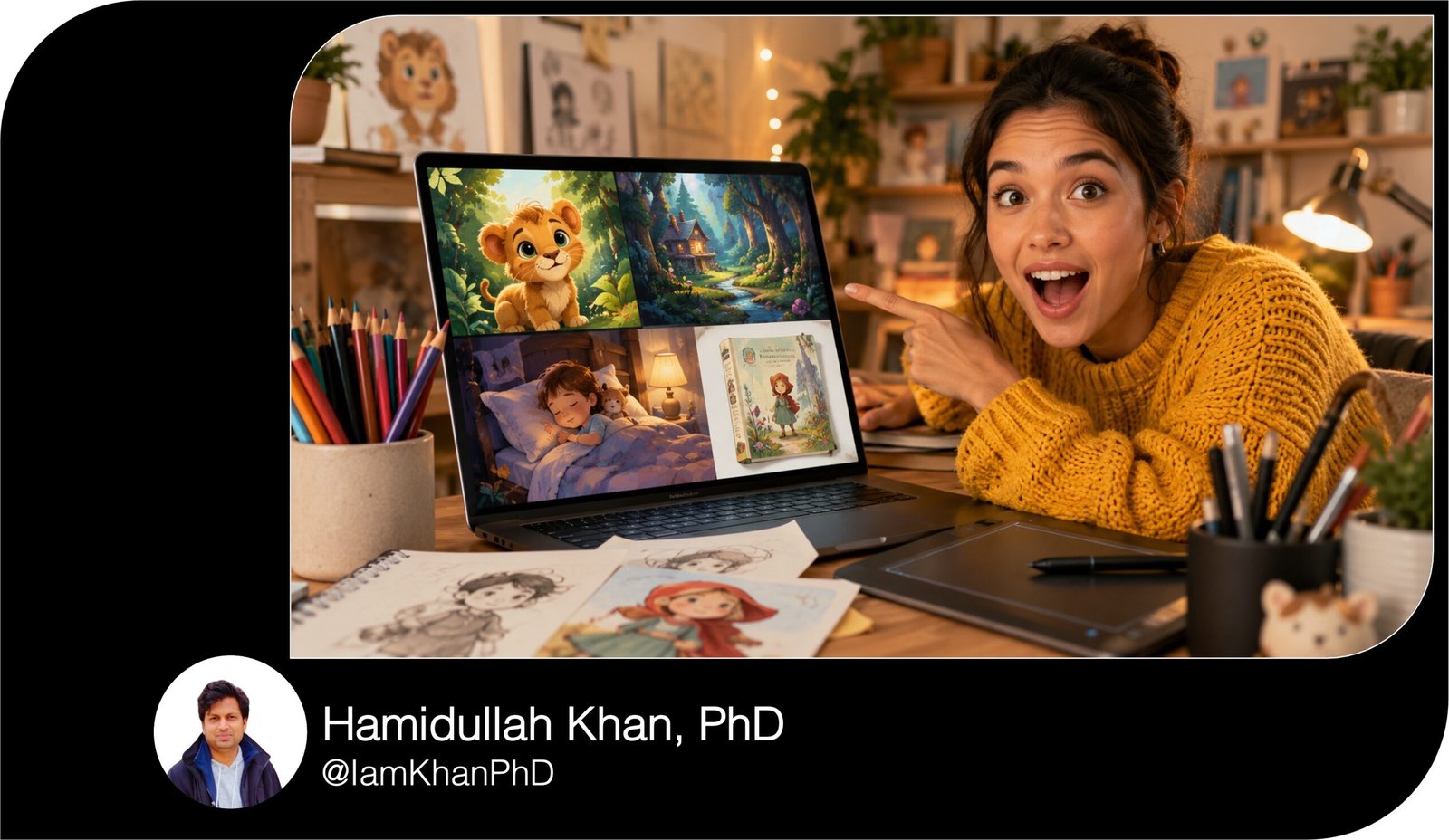
10 AI Prompts for Children’s Book Illustrations
Create beautiful, story-ready children’s book illustrations with 10 detailed and beginner-friendly AI prompts. This editable prompt pack covers character design, book covers, magical adventures, bedtime scenes, animal friendships, classroom illustrations, emotional moments, and double-page spreads.
Each prompt includes customizable placeholders for characters, settings, actions, moods, colors, illustration styles, page layouts, and composition. Ideal for authors, illustrators, self-publishers, teachers, content creators, and parents using AI image-generation tools.
What This Prompt Pack Does
- Helps users create detailed children’s book characters, covers, scenes, and interior page illustrations.
- Provides editable instructions for composition, emotions, lighting, color palettes, character consistency, and text placement.
- Reduces vague or unpredictable AI results by clearly defining the subject, action, environment, format, and unwanted elements.
Tips for Using These Prompts
- Save one complete character description and paste it into every prompt to improve visual consistency throughout the book.
- Generate several versions of each scene, then choose the image with the clearest expressions, composition, and storytelling.
- Avoid using the names of copyrighted characters or living artists; describe the visual qualities you need instead.
How to Use the Prompts
- Choose the prompt that matches the illustration you need and copy it into your preferred AI image-generation tool.
- Replace every detail inside [square brackets] with information from your children’s book.
- Review the generated image, then refine the prompt by adjusting the character description, action, mood, colors, layout, or negative instructions.
10 Copy-Paste AI Prompts for Professional Poster Design Concepts
10 Detailed AI Prompts for Children’s Book Illustrations
Create charming, colorful, and story-ready children’s book artwork using these detailed, editable AI prompts. Each prompt is designed for beginners and includes clear placeholders for characters, settings, emotions, colors, composition, and illustration style.
Editable Placeholder Guide
Replace the bracketed details with information from your story:
- [CHARACTER NAME] — the character’s name
- [AGE] — the character’s age
- [CHARACTER DESCRIPTION] — hair, clothing, facial features, species, accessories
- [SETTING] — forest, bedroom, school, castle, ocean, village, etc.
- [ACTION] — what is happening in the scene
- [MOOD] — joyful, mysterious, peaceful, exciting, emotional
- [COLOR PALETTE] — pastel, bright primary colors, earthy tones, warm sunset colors
- [ILLUSTRATION STYLE] — watercolor, soft digital painting, paper cutout, colored pencil, storybook cartoon
- [AGE GROUP] — toddlers, ages 4–6, ages 7–9
- [PAGE FORMAT] — square, portrait, landscape, full-page spread
10 AI Prompts for Modern Website Hero Images
Prompt 1: Main Character Design Sheet
Best for: Creating a consistent main character before illustrating the full book.
Copy-and-paste prompt:
Create a professional children’s book character design sheet for an original character named [CHARACTER NAME], a [AGE]-year-old [HUMAN/ANIMAL/FANTASY CREATURE].
Character appearance: [HAIR OR FUR COLOR], [EYE COLOR], [SKIN/FUR/FEATHER DETAILS], wearing [CLOTHING DESCRIPTION] and carrying [SPECIAL ACCESSORY OR OBJECT]. The character’s personality is [CURIOUS/KIND/BRAVE/SHY/FUNNY/ADVENTUROUS].
Show the same character in five clear poses:
- Standing and smiling
- Walking or running
- Feeling surprised
- Feeling sad or worried
- Celebrating happily
Include front, side, and three-quarter views. Keep the face, clothing, colors, body proportions, and accessories consistent in every pose.
Use a [WATERCOLOR/SOFT DIGITAL PAINTING/COLORED PENCIL/PAPER CUTOUT] children’s book illustration style suitable for [AGE GROUP]. Use [COLOR PALETTE], rounded shapes, friendly facial expressions, soft lighting, and clean visual details.
Place the character poses on a simple light background with enough space between each pose. Do not include text, labels, logos, watermarks, extra limbs, distorted hands, frightening details, or realistic adult facial features.
10 Midjourney Prompts for Real Estate Exterior Images
Prompt 2: Children’s Book Front Cover
Best for: Designing an attention-grabbing book cover with space for the title.
Copy-and-paste prompt:
Create a polished front-cover illustration for a children’s book titled “[BOOK TITLE]”.
The main character, [CHARACTER NAME], is a [CHARACTER DESCRIPTION] wearing [CLOTHING]. Show the character [MAIN ACTION] in [SETTING]. Include important story elements such as [OBJECT 1], [OBJECT 2], and [SECONDARY CHARACTER OR ANIMAL].
The scene should communicate a feeling of [ADVENTURE/WONDER/FRIENDSHIP/COMFORT/MYSTERY]. Use a clear visual focal point, with the main character placed [CENTER/LOWER CENTER/RIGHT SIDE].
Leave a clean, uncluttered area at the top for the book title and a smaller open area at the bottom for the author’s name. Do not generate any words or lettering inside the image.
Use a [ILLUSTRATION STYLE] style suitable for readers aged [AGE RANGE]. Use [COLOR PALETTE], expressive characters, gentle lighting, layered scenery, and a magical storybook atmosphere.
Format the artwork as a portrait book cover, with strong readability at thumbnail size. Avoid crowded composition, dark horror elements, photorealism, logos, watermarks, misshapen faces, extra fingers, duplicated characters, or text.
10 Copy-Paste AI Prompts for Fantasy Character Art
Prompt 3: Magical Forest Adventure Scene
Best for: Fantasy stories, nature adventures, quests, and magical discoveries.
Copy-and-paste prompt:
Illustrate a full-page children’s book scene featuring [CHARACTER NAME], a [CHARACTER DESCRIPTION], exploring an enchanted forest for the first time.
Show the character walking along [A GLOWING PATH/A MOSSY TRAIL/A BRIDGE MADE OF ROOTS] while discovering [MAGICAL DISCOVERY]. Surround the character with towering trees, softly glowing flowers, tiny mushrooms, floating lights, friendly woodland animals, and hidden details children can notice during repeated readings.
The character should be [LOOKING UP IN AMAZEMENT/KNEELING BESIDE A MAGICAL OBJECT/TALKING TO A SMALL ANIMAL]. Their facial expression should clearly communicate [CURIOSITY/EXCITEMENT/WONDER].
Include a visual path that guides the reader’s eye from the foreground to the character and then toward [IMPORTANT STORY ELEMENT] in the background.
Use a [WATERCOLOR/SOFT GOUACHE/DIGITAL STORYBOOK] illustration style with [COLOR PALETTE]. Create soft, child-friendly magic rather than a dark or frightening forest.
The final image should be a [SQUARE/PORTRAIT/LANDSCAPE] full-page illustration suitable for [AGE GROUP]. Keep the character’s clothing, facial features, hairstyle, colors, and proportions consistent with this description: [FULL CHARACTER REFERENCE].
Do not include text, scary monsters, sharp weapons, gloomy horror lighting, logos, watermarks, visual clutter, duplicated objects, or distorted anatomy.
10 AI Image Prompts for Interior Design Ideas
Prompt 4: Cozy Bedtime Story Scene
Best for: Bedtime books, calming stories, family moments, and gentle nighttime scenes.
Copy-and-paste prompt:
Create a peaceful children’s book illustration of [CHARACTER NAME], a [CHARACTER DESCRIPTION], getting ready for bed in a cozy bedroom.
Show the character [READING A BOOK/HUGGING A TOY/LOOKING OUT OF THE WINDOW/TALKING TO A PARENT]. The room contains [BED DESCRIPTION], [FAVORITE TOY], [BEDROOM DECORATION], and a small night-light shaped like [SHAPE OR ANIMAL].
Outside the window, show [A CRESCENT MOON/A STARRY SKY/GENTLE RAIN/SNOWFALL]. Use warm light from [A BEDSIDE LAMP/NIGHT-LIGHT/FIREPLACE] to create a safe and comforting atmosphere.
The character’s expression should feel [SLEEPY/PEACEFUL/CONTENT/LOVED]. Add small storytelling details, such as slippers beside the bed, a folded blanket, drawings on the wall, and a sleepy pet resting nearby.
Illustrate the scene in a [SOFT WATERCOLOR/PASTEL COLORED PENCIL/GENTLE DIGITAL PAINTING] style using [COLOR PALETTE]. Use rounded shapes, soft shadows, simple details, and child-friendly proportions.
Create the artwork in [PAGE FORMAT] format with an open area on [LEFT/RIGHT/TOP] for story text. Do not include actual text, frightening shadows, harsh contrast, photorealism, watermarks, logos, extra limbs, or distorted facial features.
10 AI Prompts for Realistic Food Photography
Prompt 5: Animal Friendship Illustration
Best for: Stories about kindness, teamwork, inclusion, and friendship.
Copy-and-paste prompt:
Create a heartwarming children’s book illustration showing two original animal friends: [ANIMAL CHARACTER 1] and [ANIMAL CHARACTER 2].
Character one is a [SPECIES] with [COLOR/MARKINGS], wearing [CLOTHING OR ACCESSORY], and has a [PERSONALITY] personality. Character two is a [SPECIES] with [COLOR/MARKINGS], wearing [CLOTHING OR ACCESSORY], and has a [PERSONALITY] personality.
Show the two friends [SHARING FOOD/BUILDING SOMETHING/HELPING EACH OTHER/CROSSING A STREAM/PLAYING TOGETHER] in [SETTING].
Make their friendship clear through body language: [HOLDING PAWS/SMILING AT EACH OTHER/WORKING SIDE BY SIDE/COMFORTING ONE ANOTHER]. Their expressions should be easy for young children to understand.
Add meaningful environmental details, including [OBJECT 1], [OBJECT 2], plants, small insects, and a distant background element connected to the story.
Use a [STORYBOOK CARTOON/WATERCOLOR/GOUACHE/PAPER CUTOUT] illustration style suitable for [AGE GROUP]. Use [COLOR PALETTE], soft lighting, rounded shapes, and expressive faces.
Format the scene as a [SQUARE/PORTRAIT/LANDSCAPE] illustration. Leave gentle negative space on [LEFT/RIGHT/TOP] for story text. Do not include text, aggressive behavior, realistic animal violence, scary expressions, logos, watermarks, or inconsistent character markings.
10 DALL·E Prompts for Social Media Graphics
Prompt 6: Classroom Learning Scene
Best for: Educational books, school stories, diversity-focused books, and social-emotional learning.
Copy-and-paste prompt:
Illustrate a cheerful and inclusive classroom scene for a children’s book.
The main character, [CHARACTER NAME], is a [AGE]-year-old child with CHARACTER DESCRIPTION], wearing [CLOTHING]. Show the character [RAISING A HAND/WORKING ON A PROJECT/READING WITH A FRIEND/PRESENTING AN IDEA].
Include [NUMBER] classmates with varied hairstyles, skin tones, clothing, abilities, and personalities. One classmate may use [GLASSES/A HEARING AID/A WHEELCHAIR/A COMMUNICATION BOARD], shown naturally and respectfully as part of the classroom community.
The teacher is [TEACHER DESCRIPTION] and is [HELPING A STUDENT/POINTING TO A DISPLAY/READING A STORY].
Decorate the classroom with [ART SUPPLIES/BOOKS/PLANTS/SCIENCE MODELS/NUMBER CARDS/STUDENT ARTWORK]. Keep any posters or boards free from readable text.
The emotional focus of the scene is [CURIOSITY/TEAMWORK/CONFIDENCE/KINDNESS/PROBLEM-SOLVING]. Use clear facial expressions and natural interactions.
Create the illustration in a [BRIGHT DIGITAL STORYBOOK/SOFT WATERCOLOR/COLORED PENCIL] style using [COLOR PALETTE]. Keep the composition organized, welcoming, and easy for young readers to understand.
Use a [PAGE FORMAT] layout with space for story text on [LEFT/RIGHT/TOP]. Avoid stereotypes, unreadable generated writing, crowded faces, duplicated students, logos, watermarks, distorted hands, or extra limbs.
10 AI Image Prompts for Bakery Branding
Prompt 7: Underwater Discovery Scene
Best for: Ocean stories, mermaid adventures, marine education, and fantasy journeys.
Copy-and-paste prompt:
Create a vibrant underwater children’s book illustration featuring [CHARACTER NAME], a [YOUNG DIVER/MERMAID/MERMAN/FRIENDLY SEA CREATURE] with [CHARACTER DESCRIPTION].
Show the character exploring [A CORAL REEF/A SUNKEN GARDEN/A FRIENDLY UNDERWATER VILLAGE/A GLOWING SEA CAVE] while searching for [SPECIAL OBJECT OR STORY GOAL].
Include friendly marine life such as [SEA TURTLE], [COLORFUL FISH], [OCTOPUS], [SEAHORSES], and [DOLPHIN]. Arrange the animals naturally at different distances to create depth.
The main action is [CHARACTER ACTION]. The character’s expression should communicate [WONDER/DETERMINATION/JOY/SURPRISE].
Add flowing sea plants, bubbles, patterned coral, rays of sunlight filtering through the water, and small hidden details such as [HIDDEN OBJECT] for children to discover.
Use a [LUMINOUS WATERCOLOR/SOFT DIGITAL PAINTING/PLAYFUL CARTOON] style with [COLOR PALETTE]. Make the ocean colorful, welcoming, and magical rather than dark or dangerous.
Create a [SQUARE/PORTRAIT/LANDSCAPE] composition with open space on [LEFT/RIGHT/TOP] for text. Keep the character design consistent with [FULL CHARACTER REFERENCE].
Do not include text, realistic underwater danger, sharp teeth, frightening creatures, pollution unless required by the story, logos, watermarks, distorted anatomy, or duplicated animals.
10 Midjourney Prompts for Minimalist Logo Concepts
Prompt 8: Fantasy Castle and Dragon Scene
Best for: Fairy tales, bravery stories, princess stories, magical quests, and friendly dragon books.
Copy-and-paste prompt:
Illustrate a magical children’s book scene featuring [CHARACTER NAME], a young [PRINCESS/PRINCE/KNIGHT/INVENTOR/WIZARD/ORDINARY CHILD], meeting a friendly dragon outside [CASTLE DESCRIPTION].
The main character has [CHARACTER DESCRIPTION] and wears [CLOTHING]. The dragon is [DRAGON COLOR], with [WING/HORN/SCALE DETAILS], large expressive eyes, and a gentle personality.
Show the character [OFFERING THE DRAGON FOOD/HELPING WITH AN INJURED WING/READING A MAP/INVITING THE DRAGON TO PLAY]. Make it immediately clear that the dragon is kind and safe.
Include castle towers, flags without symbols, a winding path, flowers, clouds, distant mountains, and [MAGICAL OBJECT] glowing softly nearby.
The emotional focus should be [FRIENDSHIP/COURAGE/TRUST/KINDNESS]. Use expressive poses and eye contact between the character and dragon.
Create the artwork in a [CLASSIC FAIRY-TALE WATERCOLOR/SOFT GOUACHE/DIGITAL STORYBOOK] style with [COLOR PALETTE]. Use gentle lighting, rounded shapes, detailed scenery, and a whimsical atmosphere suitable for [AGE GROUP].
Format the image as a [FULL-PAGE ILLUSTRATION/DOUBLE-PAGE SPREAD], leaving the center fold free of important faces and objects when creating a double-page spread.
Do not include text, frightening fire, violence, sharp weapons, battle scenes, logos, watermarks, photorealistic monsters, extra limbs, or inconsistent character details.
5 Viral Social Media Mega City AI Prompts
Prompt 9: Emotional Problem-and-Comfort Scene
Best for: Social-emotional learning, stories about fear, sadness, mistakes, confidence, and family support.
Copy-and-paste prompt:
Create a sensitive children’s book illustration showing [CHARACTER NAME], a [CHARACTER DESCRIPTION], experiencing [SADNESS/WORRY/FRUSTRATION/LONELINESS/FEAR] after [SIMPLE CHILD-FRIENDLY PROBLEM].
The character is sitting or standing in [SETTING], with body language that gently communicates the emotion: [LOWERED SHOULDERS/LOOKING DOWN/HOLDING A BROKEN OBJECT/WIPING AWAY A TEAR].
A supportive [PARENT/GRANDPARENT/TEACHER/FRIEND/SIBLING/ANIMAL COMPANION] is nearby, [LISTENING/HUGGING/OFFERING HELP/SITTING QUIETLY BESIDE THE CHARACTER].
Show emotional warmth without making the scene overly dramatic. The supportive character should appear calm, patient, and caring. Include small hopeful details such as [SUNLIGHT ENTERING THE ROOM/A REPAIRED TOY/A SMALL FLOWER/A RAINBOW AFTER RAIN].
Use a [SOFT WATERCOLOR/GENTLE COLORED PENCIL/WARM DIGITAL STORYBOOK] style with [COLOR PALETTE]. Use subtle lighting, clear facial expressions, soft textures, and an uncluttered composition suitable for [AGE GROUP].
Leave open space on [LEFT/RIGHT/TOP] for story text. Keep all characters consistent with these references: [CHARACTER REFERENCE DETAILS].
Do not include text, extreme crying, frightening imagery, harsh punishment, aggressive gestures, logos, watermarks, distorted hands, extra limbs, or exaggerated sadness.
10 ChatGPT Prompts to Create Minimal Desktop Mockups
Prompt 10: Consistent Double-Page Story Scene
Best for: Producing a polished interior spread while maintaining character consistency.
Copy-and-paste prompt:
Create a professional double-page spread for a children’s picture book.
The recurring main character is [CHARACTER NAME], a [AGE]-year-old [HUMAN/ANIMAL/FANTASY CREATURE] with [HAIR/FUR COLOR], [EYE COLOR], [DISTINCTIVE FACIAL FEATURE], wearing [EXACT CLOTHING DESCRIPTION] and carrying [RECURRING ACCESSORY].
In this scene, the character is [ACTION] in [SETTING]. The story moment is: [DESCRIBE WHAT HAPPENS ON THIS PAGE IN ONE OR TWO SENTENCES].
Place [IMPORTANT FOREGROUND ELEMENT] in the foreground, the main character in the middle ground, and [BACKGROUND ELEMENT] in the distance. Use the environment to guide the reader’s eye from the left page to the right page.
Keep all important faces, hands, objects, and story actions away from the center fold. Leave open negative space on [LEFT PAGE/RIGHT PAGE/UPPER AREA] for approximately [NUMBER] lines of story text. Do not generate the text.
The character must match this design exactly: [PASTE THE SAME CHARACTER DESCRIPTION USED IN EARLIER PROMPTS]. Preserve the same face shape, hairstyle, clothing colors, accessories, body proportions, and illustration style.
Use a [ILLUSTRATION STYLE] style with [COLOR PALETTE], [LIGHTING TYPE], expressive body language, layered scenery, and child-friendly details suitable for readers aged [AGE RANGE].
The final artwork should have a wide 2:1 landscape composition suitable for a double-page picture-book spread.
Do not include text, logos, watermarks, important elements in the center fold, inconsistent clothing, duplicated characters, extra fingers, distorted faces, cropped heads, or unexplained objects.


About author










Add comment