
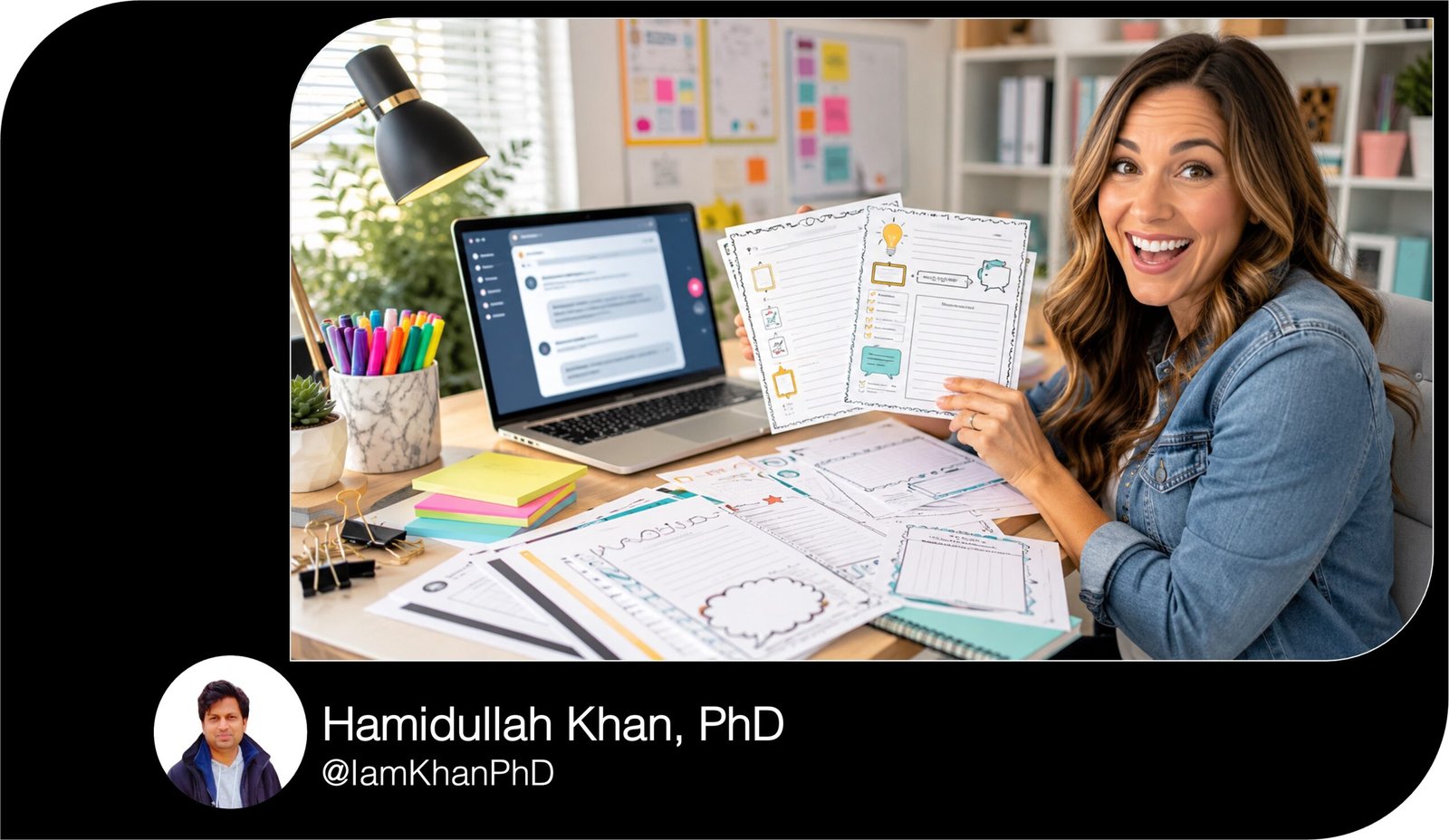
10 Middle School Writing Printable Prompts
Create engaging and classroom-ready middle school writing printables with this collection of 10 detailed AI prompts. The prompts cover narrative, opinion, informative, descriptive, persuasive, reflective, mystery, science-fiction, and historical-fiction writing.
Each prompt includes editable placeholders, worksheet instructions, graphic organizers, writing checklists, and assessment ideas. Simply customize the bracketed sections and paste the prompt into your preferred AI tool.
What This Prompt Collection Does
- Creates structured, age-appropriate writing worksheets for students in grades 6–8.
- Generates brainstorming questions, graphic organizers, sentence starters, checklists, and rubrics.
- Helps teachers, parents, tutors, and printable creators save time when developing educational resources.
Tips for Using These Prompts
- Replace every [bracketed section] with your preferred grade, word count, topic, or worksheet requirement.
- Review AI-generated educational content before giving it to students, especially facts, historical information, examples, and scoring rubrics.
- Ask the AI to revise the output for shorter lessons, struggling writers, advanced students, English-language learners, or specific classroom needs.
How to Use These Prompts
- Choose one prompt and customize the editable words inside [brackets].
- Paste the complete prompt into ChatGPT or another AI writing tool and generate the worksheet.
- Copy the result into Canva, Google Docs, Microsoft Word, or your preferred design software before editing and printing it.
FREE 3000+ AI Prompts Bundle I 22 Categories PDF Download
10 Writing Prompts for Middle School Printables
Create engaging, age-appropriate writing worksheets for middle school students with these detailed AI prompts. Each prompt can be customized by changing the words inside [brackets].
These prompts are suitable for teachers, homeschool parents, tutors, educational content creators, and printable sellers.
10 Writing Prompts for Middle School with Pictures
Prompt 1: Personal Narrative Writing Printable
Copy and paste this prompt into your preferred AI tool:
Create a printable personal narrative writing activity for students in [grade level: 6th, 7th, or 8th grade].
The main writing topic should be:
“Write about a time when you had to make a difficult decision.”
The printable must include:
- A clear, student-friendly explanation of personal narrative writing.
- The main writing prompt in a large, noticeable section.
- Five brainstorming questions that help students remember the event, the people involved, their emotions, the decision they made, and the result.
- A beginning-middle-end planning organizer.
- A list of eight transition words students can use.
- A checklist reminding students to include setting, characters, dialogue, sensory details, conflict, and reflection.
- Writing space for a [number]-paragraph response.
- A simple four-category self-assessment rubric covering ideas, organization, details, and grammar.
- A teacher answer guide explaining what a strong response may include without writing the complete response for the student.
Use language appropriate for [student age or grade]. Format the content as a clean black-and-white printable that can be copied into Microsoft Word, Google Docs, or Canva. Use clear headings, short instructions, and enough blank space for handwritten answers.
10 Writing Prompts for Middle School Girls
Prompt 2: Opinion Writing Printable
Create a printable opinion writing worksheet for [6th/7th/8th-grade] students based on this question:
“Should middle school students have homework every night?”
The worksheet should help students develop and support a clear opinion.
Include:
- A short explanation of opinion writing.
- The main question displayed prominently.
- A section where students choose “Yes,” “No,” or “It depends.”
- A pros-and-cons brainstorming chart.
- Space for students to write their main opinion statement.
- Three sections for reasons, evidence, examples, or personal experiences.
- Three possible counterarguments students may consider.
- Sentence starters for introducing an opinion, adding evidence, acknowledging another viewpoint, and writing a conclusion.
- A five-paragraph essay organizer.
- A final editing checklist for clarity, evidence, transitions, punctuation, and spelling.
- A simple grading rubric worth [20/25/30] points.
Keep the topic balanced and do not tell students which opinion is correct. Use simple directions and format the worksheet as a printer-friendly educational resource.
10 Writing Prompts for Middle School Kids
Prompt 3: Informative Writing Printable
Create a middle school informative writing printable about:
“How social media can affect students’ daily lives.”
The worksheet is for [grade level] students and should encourage factual, balanced, and age-appropriate writing.
Include:
- A simple definition of informative writing.
- The central writing task.
- Four research or thinking questions about communication, learning, entertainment, time management, and emotional well-being.
- A fact-versus-opinion sorting activity with six short statements.
- A graphic organizer with sections for:
- Introduction
- Main idea one
- Main idea two
- Main idea three
- Supporting facts or examples
- Conclusion
- Eight academic transition words.
- Sentence starters for introducing information and explaining examples.
- A reminder to avoid sharing private or sensitive personal information.
- Space for a [400–600-word] informative response.
- A student checklist covering accuracy, organization, explanations, transitions, and grammar.
- A teacher rubric with four performance levels.
Do not invent statistics or present unsupported claims as facts. Make the printable clear, modern, and suitable for classroom or homeschool use.
10 Writing Prompts for Middle School Boys
Prompt 4: Descriptive Writing Printable
Create a detailed descriptive writing worksheet for [6th/7th/8th-grade] students.
Use this writing topic:
“Describe a place that feels mysterious after dark.”
The printable should guide students through creating a vivid description without requiring a complete story.
Include:
- A student-friendly explanation of descriptive writing.
- The main prompt.
- A five-senses planning chart for sight, sound, smell, touch, and taste where appropriate.
- A word bank containing at least 20 age-appropriate descriptive words connected to darkness, weather, movement, sound, and emotion.
- A section for creating two similes, one metaphor, and one example of personification.
- Questions about the location, time, atmosphere, objects, lighting, and emotional tone.
- A paragraph organizer with a topic sentence, supporting details, and concluding sentence.
- A “show, do not tell” practice activity with five basic sentences students can improve.
- Writing space for [three/four/five] paragraphs.
- A revision checklist focusing on sensory details, precise verbs, varied adjectives, figurative language, and sentence variety.
Format it as a black-and-white printable with clear sections and plenty of writing space.
10 AI Writing Prompts for Middle School Students
Prompt 5: Persuasive Writing Printable
Create a persuasive writing printable for middle school students based on this scenario:
“Your school is considering adding one extra hour to the school day in exchange for a four-day school week. Write a persuasive response supporting or opposing the plan.”
The printable should be appropriate for [grade level].
Include:
- A brief explanation of persuasive writing.
- The scenario and writing task.
- A section for selecting a position.
- A stakeholder chart covering students, teachers, parents, school staff, and the community.
- A benefits-and-challenges organizer.
- Space for three persuasive reasons and supporting evidence.
- A counterclaim and rebuttal section.
- Ten persuasive sentence starters.
- A five-paragraph essay outline.
- A strong-introduction builder that includes a hook, background information, and thesis statement.
- A conclusion builder that includes restating the position, summarizing reasons, and presenting a final call to action.
- A student editing checklist.
- A persuasive writing rubric with categories for position, evidence, organization, counterclaim, word choice, and conventions.
Keep the worksheet neutral so students can argue either side.
10 Prompts for Middle School Writing Worksheets
Prompt 6: Compare-and-Contrast Writing Printable
Create a compare-and-contrast writing worksheet for [6th/7th/8th-grade] students.
The topic should be:
“Compare learning in a traditional classroom with learning online.”
Include:
- A clear explanation of compare-and-contrast writing.
- The main writing question.
- A Venn diagram presented as three labeled text sections:
- Traditional classroom only
- Similarities
- Online learning only
- Guiding questions about communication, flexibility, technology, social interaction, teacher support, distractions, and learning environment.
- A section where students choose block organization or point-by-point organization.
- An outline for both organizational methods.
- Twelve compare-and-contrast transition words and phrases.
- Sentence starters for similarities, differences, examples, and conclusions.
- Space for a thesis statement.
- A writing section for a [four/five]-paragraph essay.
- A revision checklist covering balanced discussion, clear comparisons, specific examples, organization, and grammar.
- A simple teacher scoring guide.
Do not suggest that one learning method is automatically better. Allow students to reach their own conclusion.
10 Persuasive Writing Prompts for Middle School Students
Prompt 7: Reflective Journal Writing Printable
Create a reflective journal writing printable for middle school students using this topic:
“What is one skill you would like to improve this year, and what steps will you take?”
The worksheet should be suitable for [grade level or age range].
Include:
- A short explanation of reflective writing.
- The main journal question.
- A list of possible skill categories, including academic, creative, athletic, communication, organization, technology, and personal responsibility.
- Questions that help students identify why the skill matters.
- A strengths-and-challenges reflection chart.
- A SMART goal organizer covering specific, measurable, achievable, relevant, and time-based goals.
- Space for three action steps.
- A section for possible obstacles and solutions.
- A weekly progress tracker for [four/six/eight] weeks.
- Reflection sentence starters.
- A final paragraph section where students explain how improving the skill could affect their future.
- A private-information reminder telling students not to include details they are uncomfortable sharing.
Use a positive, encouraging tone without sounding childish.
10 Daily Writing Prompts for Middle School Students
Prompt 8: Mystery Story Writing Printable
Create a mystery story writing printable for [6th/7th/8th-grade] students.
Use this story starter:
“When the final bell rang, every clock in the school suddenly stopped at exactly 2:17.”
The printable should include:
- The story starter displayed prominently.
- A short explanation of mystery story elements.
- A character planner for the detective, suspect, witness, and supporting character.
- A setting planner covering location, time, atmosphere, and important objects.
- Space for students to create the central mystery.
- A clue organizer with sections for three real clues, two misleading clues, and one important discovery.
- A suspect chart containing motive, opportunity, evidence, and possible secret.
- A plot organizer covering opening, strange event, investigation, complication, discovery, solution, and ending.
- A suspense word bank with at least 20 words and phrases.
- Dialogue-writing tips and punctuation reminders.
- A checklist reminding students to make the final solution logical and connected to earlier clues.
- Writing space for a [1,000–1,500-word] story.
- A peer-review checklist.
- A creative-writing rubric.
Keep all examples school-appropriate and avoid graphic violence.
10 Five-Minute Writing Prompts for Middle School
Prompt 9: Science-Fiction Writing Printable
Create a science-fiction writing worksheet for middle school students based on this prompt:
“A student receives a message from their future self, warning them not to attend school the next day.”
The printable is for [grade level] and should support creative but logically organized writing.
Include:
- A simple explanation of science-fiction writing.
- The main story prompt.
- A world-building organizer covering time period, technology, location, rules, and possible dangers.
- A main-character profile.
- Questions about the future message, including how it arrived, what it said, whether it can be trusted, and what could happen next.
- A cause-and-effect chart.
- A conflict planner covering internal conflict and external conflict.
- A three-act story outline:
- Beginning and discovery
- Rising problems and major decision
- Final consequence and resolution
- A science-fiction vocabulary bank.
- Space for students to invent one futuristic tool and explain how it works.
- A section for selecting an ending type: hopeful, surprising, unresolved, or cautionary.
- A revision checklist covering consistency, character decisions, setting details, tension, dialogue, and grammar.
- A four-level creative-writing rubric.
Avoid overly technical scientific language unless it is explained for middle school readers.
10 Fiction Writing Prompts for Middle School Students
Prompt 10: Historical Fiction Writing Printable
Create a historical fiction writing printable for [6th/7th/8th-grade] students.
Use this flexible scenario:
“Imagine you are a young person living during [historical event, location, and year]. Write about one important day in your life.”
Include:
- A simple explanation of historical fiction.
- The customizable writing prompt.
- A research planning section for the date, location, important events, daily life, clothing, food, transportation, communication, and social expectations.
- A reminder to separate confirmed historical facts from invented story details.
- A character profile appropriate to the selected historical setting.
- A setting description organizer.
- Space for recording five verified historical facts.
- A plot planner containing an ordinary routine, an important event, a personal challenge, a decision, and a realistic resolution.
- Questions that help students consider how the historical event affects the character personally.
- Dialogue tips that discourage modern slang unless historically appropriate.
- A vocabulary section for words connected to the selected period.
- Writing space for a [750–1,250-word] story.
- A source-recording section.
- A historical-accuracy and writing-quality checklist.
- A rubric covering research, historical setting, character, plot, details, and conventions.
Do not invent historical facts. Clearly mark any information that should be verified by the teacher or student.


About author










Add comment