
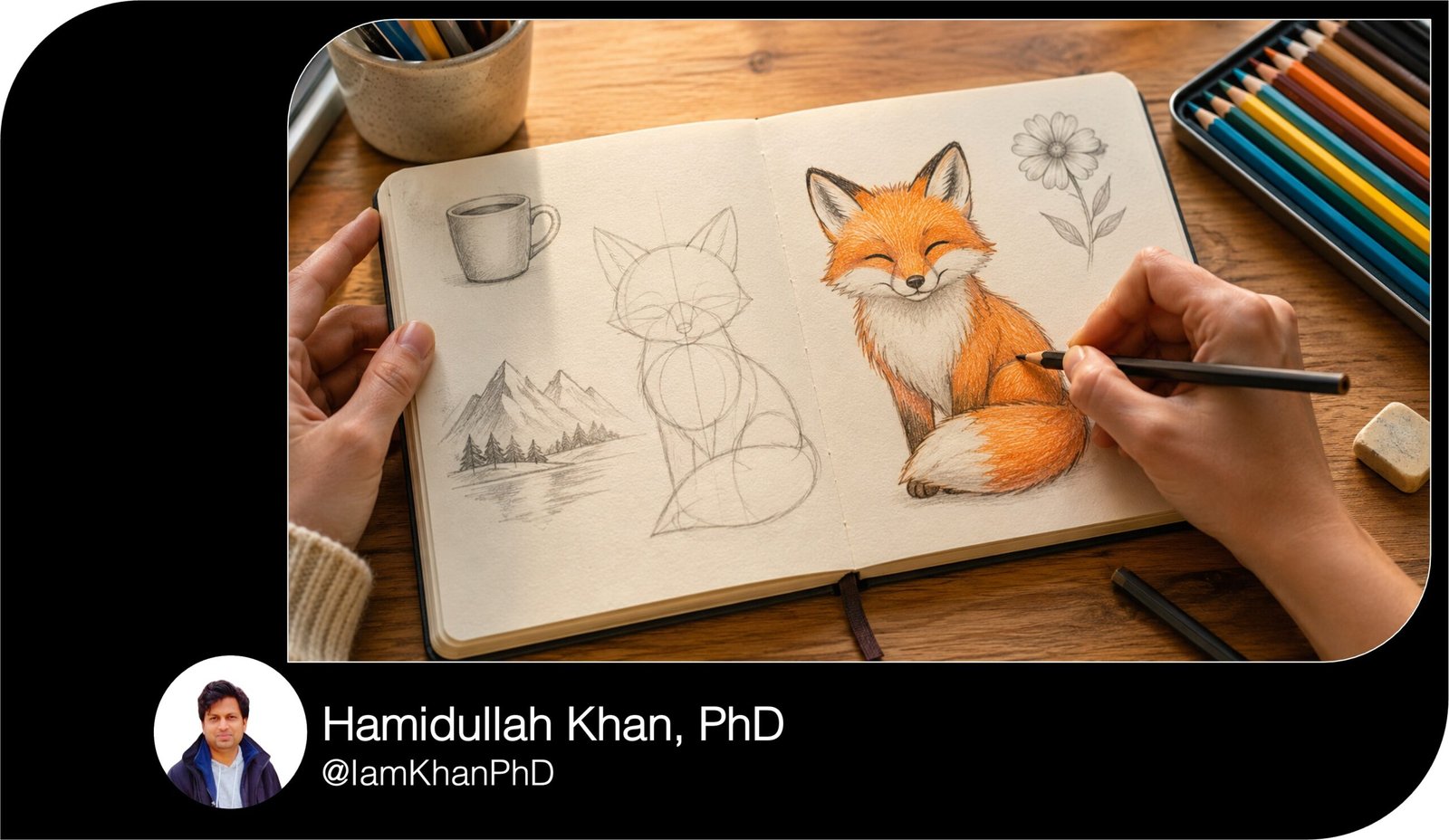
10 AI Drawing Prompts for Beginners I Editable Prompt Pack
Build confidence and improve your drawing skills with this collection of 10 detailed, editable AI prompts for beginners. Each prompt turns your chosen AI assistant into a patient art teacher, providing structured lessons for objects, animals, landscapes, portraits, perspective, shading, character design, and more. Simply customize the bracketed sections, paste the prompt into your AI tool, and follow the personalized instructions.
What This Prompt Pack Does
- Creates personalized, step-by-step drawing lessons based on the user’s subject, tools, skill level, and available time.
- Helps beginners practice essential skills such as proportions, perspective, shading, composition, and character design.
- Provides checkpoints, mistake corrections, optional challenges, and self-assessment guidance.
Tips for This Prompt Pack
- Be specific when replacing the bracketed text; “orange tabby cat sitting sideways” will produce better guidance than “cat.”
- Ask the AI to simplify any step you do not understand or request a visual description of the required shapes.
- Complete the first attempt without aiming for perfection, then repeat the exercise and focus on one improvement.
How to Use the Prompts
- Choose the prompt that matches the type of drawing you want to practice.
- Replace every [bracketed section] with your own subject, materials, preferences, and time limit.
- Paste the edited prompt into ChatGPT or another AI assistant, then follow the generated lesson one step at a time.
FREE 3000+ AI Prompts Bundle I 22 Categories PDF Download
10 Editable Drawing Prompts for Beginners
Replace the words inside [brackets] with your preferences, then paste the complete prompt into ChatGPT or another AI assistant.
10 Kindergarten Drawing Prompts I Editable AI Prompt Pack
1. Draw an Everyday Object Step by Step
Act as a patient drawing teacher for a complete beginner. Teach me how to draw a [object, such as a coffee mug, key, shoe, or lamp] using [pencil/colored pencil/digital drawing].
My skill level is [complete beginner/some basic experience], and I have [10/20/30] minutes.
Please:
- Break the object into simple shapes such as circles, rectangles, and curved lines.
- Give me no more than eight numbered drawing steps.
- Explain where to place each shape on the page.
- Tell me which lines should be light sketch lines and which should be darker final lines.
- Add one simple light source and explain where to place the shadows.
- Include a short checkpoint after every two steps so I can compare proportions.
- Mention three common beginner mistakes and how to correct them.
- End with one easy optional detail that will make the drawing look more polished.
Use friendly, simple language and avoid advanced art terminology unless you explain it.
10 Drawing Prompts for Middle School I Editable AI Prompts
2. Draw a Cute Animal Character
Be my beginner-friendly cartoon drawing coach. Help me draw a cute [animal] character in a [sitting/standing/sleeping/running] pose. The character should have a [happy/shy/sleepy/playful] expression and a simple [accessory, such as a scarf, hat, or backpack].
I will use [pencil/markers/digital drawing], and I want the drawing to fit on [A4 paper/a sketchbook page/a square digital canvas].
Create a guided lesson that includes:
- A list of the basic shapes needed for the head, body, legs, and facial features.
- Step-by-step instructions suitable for someone who struggles with proportions.
- Clear guidance for placing the eyes, nose, mouth, ears, and limbs.
- A simple method for making both sides of the face look balanced.
- Instructions for cleaning up the sketch and outlining the final character.
- A limited color palette of [number] colors, with suggested colors if I need help.
- One easy background element that matches the character.
- A final checklist covering expression, balance, clean lines, and color.
Keep the design simple enough to complete in [15/30/45] minutes.
10 Creative AI Drawing Prompts for Teen Artists
3. Draw a Peaceful Landscape
Act as an encouraging art instructor and create a beginner drawing lesson for a peaceful [mountain/beach/forest/countryside/desert] landscape during [sunrise/daytime/sunset/night].
I want to draw it using [graphite pencils/colored pencils/markers/digital brushes] on a [portrait/landscape/square] canvas.
Please provide:
- A simple composition plan showing where to place the horizon, foreground, middle ground, and background.
- A list of five to seven basic elements to include.
- Numbered instructions for sketching the largest shapes before adding details.
- An explanation of how objects should become smaller and lighter in the distance.
- A beginner-friendly shading or coloring plan.
- Suggestions for three colors or pencil values for light, medium, and dark areas.
- One simple technique for creating texture in [trees/water/clouds/rocks/grass].
- Three mistakes that can make a landscape look flat and how to avoid them.
- A final five-minute polishing routine.
Keep the scene uncluttered and achievable in [30/45/60] minutes.
10 Drawing Prompts for Adults I Editable AI Art Ideas
4. Draw a Simple Human Face
Act as a patient portrait teacher. Teach me how to draw a front-facing human face for the first time using [pencil/charcoal/digital drawing].
The person should appear [age range] with a [calm/happy/serious/surprised] expression and [short/long/curly/straight] hair.
Please:
- Begin with the head shape and easy construction guidelines.
- Explain exactly where to place the eye line, nose, mouth, ears, and hairline.
- Use simple measurements, such as “halfway down the head,” instead of advanced anatomy terms.
- Show me how to check whether the eyes and facial features are aligned.
- Explain how to draw the eyes, nose, lips, and hair without adding too much detail.
- Use one light source from [left/right/front] and identify the main shadow areas.
- Give me a simple three-value shading plan: light, medium, and dark.
- Include four common beginner portrait mistakes and quick corrections.
- End with a checklist I can use before darkening my final lines.
Keep the result realistic but simple, with no professional-level detail required.
10 Editable AI Drawing Prompts for Kids: Fun Creative Activities
5. Draw a Room Using One-Point Perspective
Be my beginner perspective-drawing tutor. Guide me through drawing a simple [bedroom/living room/study/art studio] using one-point perspective.
The room should include [three to five pieces of furniture], and the main focal object should be [bed/desk/sofa/window/bookshelf].
Create a lesson that:
- Explains the horizon line and vanishing point in plain language.
- Tells me exactly where to place the vanishing point.
- Shows how to draw the back wall, floor, ceiling, and side walls.
- Explains which furniture lines should point toward the vanishing point.
- Breaks each piece of furniture into boxes or rectangles.
- Includes a simple floor pattern to help me understand depth.
- Adds one light source from [window/lamp/ceiling light].
- Explains how to add shadows without ruining the perspective.
- Lists three perspective errors beginners commonly make.
- Ends with two optional decorative details.
Keep the instructions suitable for a ruler and pencil, and limit the drawing to [30/45/60] minutes.
6. Draw a Flower or Plant Study
Act as a beginner botanical drawing teacher. Help me draw a [flower, leaf, houseplant, cactus, or herb] from [a real object/a reference photo/imagination] using [pencil/fineliner/colored pencil/watercolor/digital drawing].
Please create a structured exercise that includes:
- A short observation checklist covering overall shape, direction, size, and repeated patterns.
- Instructions for lightly sketching the stem or central line first.
- A method for building petals or leaves around the center.
- Guidance for making the plant look natural instead of perfectly symmetrical.
- Close-up instructions for drawing one petal or leaf.
- A simple technique for showing veins and texture without drawing every detail.
- A shading plan based on light coming from [left/right/above].
- A suggested palette of [three/five] colors if color is being used.
- Three beginner mistakes and how to fix them.
- One optional element, such as a pot, label, small insect, or background shadow.
Make the finished drawing clean, simple, and suitable for a beginner’s sketchbook.
7. Create an Original Cartoon Character
Act as a character-design coach for someone with basic drawing skills. Help me create an original cartoon character based on this idea:
- Character type: [human/animal/fantasy creature/robot]
- Personality: [cheerful/brave/clumsy/mysterious/curious]
- Role: [student/explorer/chef/inventor/hero]
- Special feature: [oversized glasses/tiny wings/robot arm/unusual hairstyle]
- Art style: [simple cartoon/chibi/storybook/doodle]
Guide me through:
- Choosing a circle, square, or triangle as the character’s main shape.
- Creating a clear silhouette using simple body parts.
- Selecting proportions for the head, body, arms, and legs.
- Designing a face that communicates the chosen personality.
- Creating a simple outfit using no more than four main clothing elements.
- Drawing the character in a neutral pose and one expressive pose.
- Choosing a five-color palette that fits the personality.
- Adding one prop connected to the character’s role.
- Checking that the design is easy to redraw.
- Creating a short character profile with a name, strength, weakness, and favorite activity.
Avoid copying existing copyrighted characters. Keep the design original and beginner-friendly.
10 AI Drawing Prompts for Kids
8. Practice Light, Shadow, and Shading
Act as a drawing instructor specializing in beginner shading. Create a practical exercise using a [sphere/cube/cylinder/simple group of all three] drawn with [graphite pencil/charcoal/colored pencil/digital brush].
The light source should come from [upper left/upper right/directly above].
Please explain:
- How to sketch the selected shape accurately.
- Where the highlight, light area, midtone, core shadow, reflected light, and cast shadow should appear.
- How to create a five-step value scale before shading the object.
- Which pencil grades or digital brush settings to use, if relevant.
- How much pressure to apply in each value area.
- How to blend while keeping the drawing clean.
- How the cast shadow’s direction and softness are determined.
- A step-by-step shading order that prevents muddy results.
- Four common shading problems and how to correct them.
- A final self-assessment scored from 1 to 5 for shape, light direction, smoothness, and contrast.
Use plain language and define every art term when it first appears.
9. Turn a Simple Still Life into a Drawing
Be my personal drawing coach. Help me arrange and draw a beginner still life using these objects: [object 1], [object 2], and [object 3].
I will use [pencil/colored pencil/charcoal/digital drawing], and the light will come from [a window/a desk lamp/above].
Please:
- Suggest an easy arrangement in which the objects overlap slightly.
- Explain which object should be the focal point and why.
- Show me how to measure relative height and width using my pencil or stylus.
- Break every object into basic shapes.
- Guide me from a light construction sketch to clean final contours.
- Explain how to draw overlapping objects without confusing their edges.
- Identify the lightest, middle, and darkest areas.
- Add cast shadows that make the objects appear grounded.
- Give me a timed plan for a [20/40/60]-minute drawing session.
- Provide a final checklist for proportions, overlaps, shadows, and visual balance.
Make the exercise challenging enough to teach me something but simple enough for a first still-life drawing.
10 Easy Drawing Prompts for Beginners
10. Create a Seven-Day Beginner Drawing Challenge
Act as a supportive drawing teacher and design a personalized seven-day drawing challenge for me.
My preferred subjects are [animals/people/nature/objects/cartoons/buildings]. I use [pencil/colored pencils/markers/digital drawing], and I can practice for [10/20/30] minutes per day. My biggest difficulty is [proportions/shading/perspective/clean lines/knowing what to draw].
Create a table with one lesson for each day. For every lesson, include:
- A specific subject to draw—not a vague theme.
- The exact skill being practiced.
- A short warm-up exercise.
- Five to seven numbered drawing steps.
- A suggested time limit for the sketch, details, and finishing stage.
- One beginner mistake to watch for.
- A simple success check I can use without needing a teacher.
- An optional challenge for extra practice.
Make each day slightly more difficult than the previous day. On Day 7, create a small final drawing that combines at least three skills learned earlier. End with a short reflection checklist and a suggestion for what to practice next.

About author







Add comment