
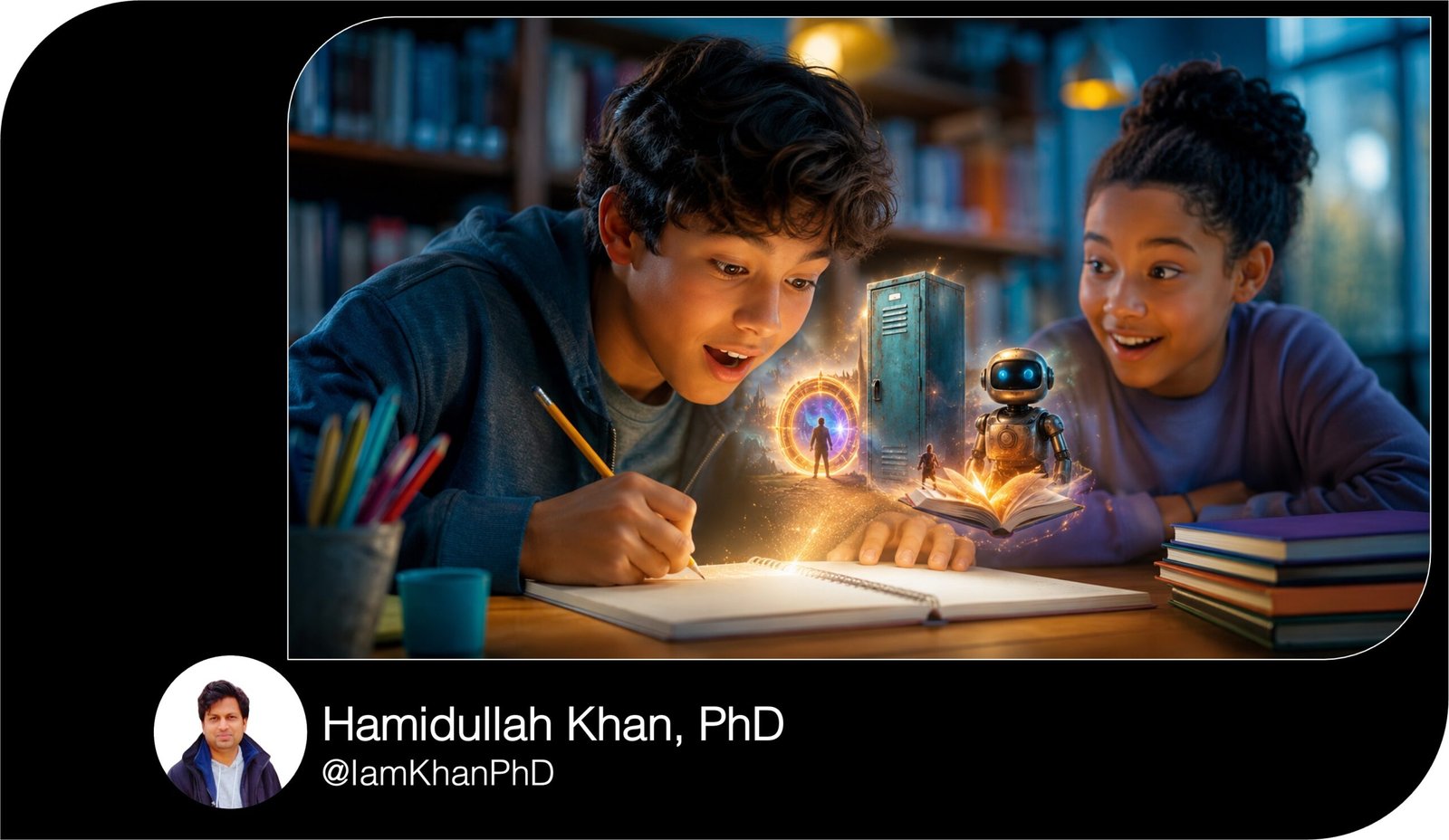
10 Short Story Writing Prompts for Middle School
Inspire young writers with 10 detailed, editable AI prompts created especially for middle school storytelling. This collection covers mystery, fantasy, science fiction, adventure, and realistic fiction. Each beginner-friendly prompt includes customizable characters, settings, conflicts, themes, length requirements, and writing instructions—making it easy to generate original, age-appropriate short stories with almost any AI writing tool.
What This Prompt Collection Does
- Helps students create structured short stories with a clear beginning, conflict, climax, and resolution.
- Provides editable options for characters, settings, genres, themes, story lengths, and endings.
- Encourages creativity while requesting age-appropriate vocabulary, dialogue, description, and content.
Tips for These Prompts
- Replace every bracketed section with specific details to make the resulting story more original.
- Treat the AI’s first story as a draft, then ask it to improve the dialogue, pacing, descriptions, or ending.
- Encourage students to add their own ideas and rewrite parts in their personal voice rather than submitting unchanged AI-generated text.
How to Use the Prompts
- Choose one prompt and replace the information inside [square brackets].
- Copy the completed prompt and paste it into ChatGPT or another AI writing tool.
- Review the result, check facts where necessary, and request revisions until the story matches your vision.
1. The Locker That Shouldn’t Exist
Act as a creative writing partner for a middle school student. Write an original short story about a student who discovers a mysterious locker that does not appear on the school map.
Use these details:
- Main character: [NAME], a [AGE]-year-old student who is [PERSONALITY TRAIT]
- School setting: [DESCRIBE THE SCHOOL]
- Locker number: [NUMBER OR SYMBOL]
- Strange object inside the locker: [OBJECT]
- Main character’s biggest fear: [FEAR]
- Friend or classmate who helps: [NAME AND PERSONALITY]
- Secret connected to the locker: [SECRET, OR WRITE “SURPRISE ME”]
- Desired ending: [HAPPY / MYSTERIOUS / SURPRISING / BITTERSWEET]
- Story length: [700–1,000 WORDS]
Begin with the main character noticing something unusual in the hallway. Build suspense by including three clues about the locker’s origin. Introduce a difficult decision near the climax, and show how the character’s choice reveals courage, honesty, or friendship.
Use vocabulary appropriate for grades 6–8, natural dialogue, sensory descriptions, and short, readable paragraphs. Keep the story age-appropriate and avoid graphic violence. Give the story an interesting title and end with one memorable final sentence.
2. The School Field Trip Time Portal
Act as an imaginative short-story writer. Create an age-appropriate adventure for a middle school audience about a school field trip that accidentally transports three students into another time period.
Customize the story with these choices:
- Main student: [NAME, AGE, AND PERSONALITY]
- Two classmates: [NAMES AND PERSONALITIES]
- Field trip location: [MUSEUM / HISTORIC SITE / SCIENCE CENTER]
- Time period they enter: [TIME PERIOD]
- Object that activates the portal: [OBJECT]
- Historical person they meet: [PERSON, OR “FICTIONAL CHARACTER”]
- Item they must recover: [ITEM]
- Time limit for returning: [NUMBER OF HOURS]
- Important lesson: [TEAMWORK / COURAGE / RESPECTING HISTORY / ANOTHER LESSON]
- Story length: [800–1,200 WORDS]
Open the story during an ordinary field trip, shortly before something impossible happens. Include one historically believable setting detail, but do not turn the story into a history lesson. Give each student a different skill that helps the group. Add a setback that makes returning home seem impossible and a climax in which the students must work together.
Use lively dialogue, action, humor, and vivid descriptions suitable for grades 6–8. Avoid graphic violence. End by showing one small object or change that suggests the adventure really happened. Add an original title.
3. The New Student’s Impossible Secret
Write an original science-fiction short story for middle school readers about a new student who is secretly an advanced robot learning how to behave like a human.
Use the following editable details:
- Narrator: [NAME, AGE, AND PERSONALITY]
- New student: [NAME]
- School location: [CITY OR TYPE OF COMMUNITY]
- First unusual behavior the narrator notices: [BEHAVIOR]
- Special ability the robot has: [ABILITY]
- School event where the secret is threatened: [EVENT]
- Person trying to expose the new student: [CHARACTER]
- Reason the robot was sent to the school: [REASON, OR “SURPRISE ME”]
- Main theme: [FRIENDSHIP / ACCEPTANCE / TRUST / WHAT MAKES SOMEONE HUMAN]
- Ending style: [HOPEFUL / FUNNY / SURPRISING]
- Length: [700–1,000 WORDS]
Tell the story from the narrator’s point of view. Plant at least three clues before revealing the secret. Include a scene where the robot misunderstands an ordinary middle school expression or custom. During the climax, force the narrator to decide whether to protect the new student or reveal the truth.
Use age-appropriate vocabulary, believable dialogue, humor, and emotional moments without making the message sound like a lecture. Include a creative title and finish with a final line that hints at another secret.
4. When the Town Lost Its Colors
Act as a fantasy author writing for students in grades 6–8. Create a short story about a town where every color disappears overnight—except for one color that only the main character can see.
Story details:
- Main character: [NAME, AGE, AND PERSONALITY]
- Town name: [NAME]
- Remaining color: [COLOR]
- Magical creature or guide: [CREATURE]
- Location where the colors are trapped: [LOCATION]
- Person responsible for the problem: [CHARACTER OR “UNKNOWN FORCE”]
- Reason the colors disappeared: [REASON, OR “SURPRISE ME”]
- Character flaw the hero must overcome: [FLAW]
- Object needed to restore the colors: [OBJECT]
- Ending: [JOYFUL / THOUGHT-PROVOKING / SURPRISING]
- Length: [800–1,100 WORDS]
Begin with the character waking up and realizing that something feels wrong. Describe familiar places without using color words until the remaining color appears. Give that color an important meaning in the story. Include three magical obstacles, but make at least one obstacle solvable through kindness or creativity instead of strength.
Build toward a climax where the main character must sacrifice something meaningful or overcome their flaw. Use vivid sensory language, natural dialogue, and age-appropriate suspense. Avoid graphic violence. Provide an imaginative title and a satisfying ending.
5. The Science Fair Experiment That Answered Back
Write a funny but suspenseful science-fiction story for middle school readers about a student whose science fair experiment begins communicating with them.
Customize it using these details:
- Student scientist: [NAME, AGE, AND PERSONALITY]
- Experiment: [TYPE OF EXPERIMENT]
- How it communicates: [TEXT / SOUND / LIGHTS / MOVEMENT]
- First message: [MESSAGE]
- Science fair partner: [NAME AND PERSONALITY]
- Rival student: [NAME AND MOTIVATION]
- Dangerous or embarrassing problem: [PROBLEM]
- Adult who almost discovers the truth: [TEACHER / PARENT / JUDGE]
- Scientific idea to include: [SIMPLE SCIENCE CONCEPT]
- Theme: [RESPONSIBILITY / HONESTY / CURIOSITY / TEAMWORK]
- Length: [700–1,000 WORDS]
Start the night before the science fair. Make the experiment’s first message surprising and slightly funny. Include at least two failed attempts to control or hide it. During the science fair, create a crisis that forces the main character to choose between winning and doing the right thing.
Explain the selected science concept accurately in simple language, but keep the focus on the story. Use believable middle school dialogue, humor, sensory descriptions, and a clear beginning, middle, climax, and resolution. Add an original title and end by revealing one last unexpected message.
6. Trapped Overnight in the Library
Create a mystery-adventure short story suitable for grades 6–8 about two students who accidentally become locked inside their school library overnight and discover that characters are escaping from the books.
Use these editable details:
- Main student: [NAME, AGE, AND PERSONALITY]
- Second student: [NAME AND PERSONALITY]
- Reason they were in the library late: [REASON]
- First fictional character to appear: [CHARACTER TYPE]
- Villain that escapes: [VILLAIN TYPE]
- Magical library rule: [RULE]
- Book that contains the solution: [BOOK TITLE OR DESCRIPTION]
- Personal disagreement between the students: [DISAGREEMENT]
- Deadline: [MIDNIGHT / SUNRISE / ANOTHER TIME]
- Ending style: [FUNNY / MAGICAL / SUSPENSEFUL]
- Length: [800–1,200 WORDS]
Open with the lights turning off and the library doors locking. Gradually reveal that the books are changing. Include three clues that help the students understand the magical rule. Let fictional characters from different genres interact in surprising ways.
Create a climax where the students must enter a book or rewrite part of a story to save the library. Resolve their disagreement through cooperation. Use vivid descriptions, quick-paced action, natural dialogue, and age-appropriate suspense. Avoid graphic violence. Give the story a creative title and end with a subtle sign that the magic is not completely gone.
7. The Storm That Changed the Team
Write a realistic, emotionally engaging short story for middle school students about a group of classmates who must cooperate when a severe storm interrupts an outdoor school activity.
Use the following details:
- Main character: [NAME, AGE, AND PERSONALITY]
- Outdoor activity: [CAMPING TRIP / SPORTS DAY / NATURE HIKE]
- Setting: [LOCATION]
- Student the main character dislikes: [NAME AND REASON]
- Useful skill that student possesses: [SKILL]
- Problem caused by the storm: [PROBLEM]
- Limited supplies available: [LIST 3–5 ITEMS]
- Adult leader’s situation: [DESCRIBE THE SITUATION]
- Main lesson: [TEAMWORK / LETTING GO OF ASSUMPTIONS / LEADERSHIP]
- Ending: [HOPEFUL / REFLECTIVE]
- Length: [800–1,100 WORDS]
Start with tension between the main character and the disliked classmate before the weather changes. Describe the storm through sights, sounds, temperature, and movement. Keep all emergency actions realistic and safe. Do not include graphic injuries.
Give the main character one failed attempt to solve the problem alone. During the climax, make the students combine their different skills to reach safety or help someone. Show the characters’ changing opinions through actions and dialogue rather than directly explaining everything. Add an engaging title and finish with a thoughtful final image.
8. One Day Without Technology
Act as a speculative-fiction writer for a middle school audience. Write a short story set in the near future, where one community suddenly loses access to every digital device for twenty-four hours.
Customize the story:
- Main character: [NAME, AGE, AND PERSONALITY]
- Community: [CITY / SMALL TOWN / SCHOOL CAMPUS]
- Technology the character depends on most: [DEVICE OR SERVICE]
- Important task they must complete: [TASK]
- Person they must work with: [NAME AND RELATIONSHIP]
- Non-digital skill they need to learn: [SKILL]
- Cause of the shutdown: [KNOWN CAUSE / MYSTERY / “SURPRISE ME”]
- Major complication: [COMPLICATION]
- Theme: [BALANCE / COMMUNICATION / RESOURCEFULNESS / COMMUNITY]
- Ending style: [OPTIMISTIC / HUMOROUS / THOUGHT-PROVOKING]
- Length: [700–1,000 WORDS]
Begin at the exact moment the technology stops working. Show three practical ways daily life changes. Avoid presenting technology as entirely good or entirely bad. Include humor created by characters trying to remember how older tools work.
Build toward a problem that cannot be solved by simply waiting for the devices to return. Let the main character use observation, communication, and teamwork to solve it. Use believable dialogue, clear descriptions, and vocabulary appropriate for grades 6–8. Add a strong title and end by showing one habit the character decides to change.
9. The Rival Who Knew the Truth
Write an age-appropriate realistic-fiction story about two middle school rivals forced to work together after they discover that someone is cheating during an important school competition.
Use these story choices:
- Main character: [NAME, AGE, AND PERSONALITY]
- Rival: [NAME AND PERSONALITY]
- Competition: [SPORTS / DEBATE / QUIZ / ART / MUSIC / OTHER]
- Reason for their rivalry: [REASON]
- Evidence they discover: [EVIDENCE]
- Person suspected of cheating: [CHARACTER]
- Consequence of speaking up: [CONSEQUENCE]
- Trusted adult: [TEACHER / COACH / COUNSELOR]
- Theme: [FAIRNESS / COURAGE / HONESTY / EMPATHY]
- Desired ending: [VICTORY / LOSS WITH A LESSON / UNEXPECTED RESULT]
- Length: [800–1,100 WORDS]
Begin during a tense moment in the competition. Show the rivalry through actions and dialogue. Let both characters initially interpret the evidence differently. Include one misleading clue and one moment when the main character considers staying silent.
At the climax, have the rivals make a difficult but believable ethical choice. Do not make any character completely perfect or completely evil. Show realistic consequences and allow the characters to learn something about each other. Use natural dialogue and accessible vocabulary for grades 6–8. Provide a compelling title and a satisfying final scene.
10. The Message From My Future Self
Create an original science-fiction short story for middle school readers about a student who receives a message from their future self warning them not to make one specific decision.
Complete these details:
- Main character: [NAME, AGE, AND PERSONALITY]
- Form of the message: [LETTER / VIDEO / VOICE RECORDING / OBJECT]
- Decision mentioned in the warning: [DECISION]
- Date the message came from: [FUTURE DATE]
- Best friend or sibling involved: [NAME AND RELATIONSHIP]
- Event happening that day: [EVENT]
- Strange detail proving the message is real: [DETAIL]
- Unexpected consequence of obeying the warning: [CONSEQUENCE]
- Theme: [CHOICES / RESPONSIBILITY / FRIENDSHIP / FACING FEAR]
- Ending: [HOPEFUL / TWIST / OPEN-ENDED]
- Length: [800–1,200 WORDS]
Open with the main character finding the message in an impossible place. Reveal its warning early, but slowly explain why the decision matters. Include three clues about the future and one clue that the main character misunderstands.
Create a climax where the character must choose whether to obey the message, ignore it, or find a third solution. Make the consequences logical within the story. Use suspense, natural dialogue, sensory details, and age-appropriate vocabulary. Avoid graphic violence. Give the story a memorable title and end with a new message containing no more than one sentence.


About author










Add comment