
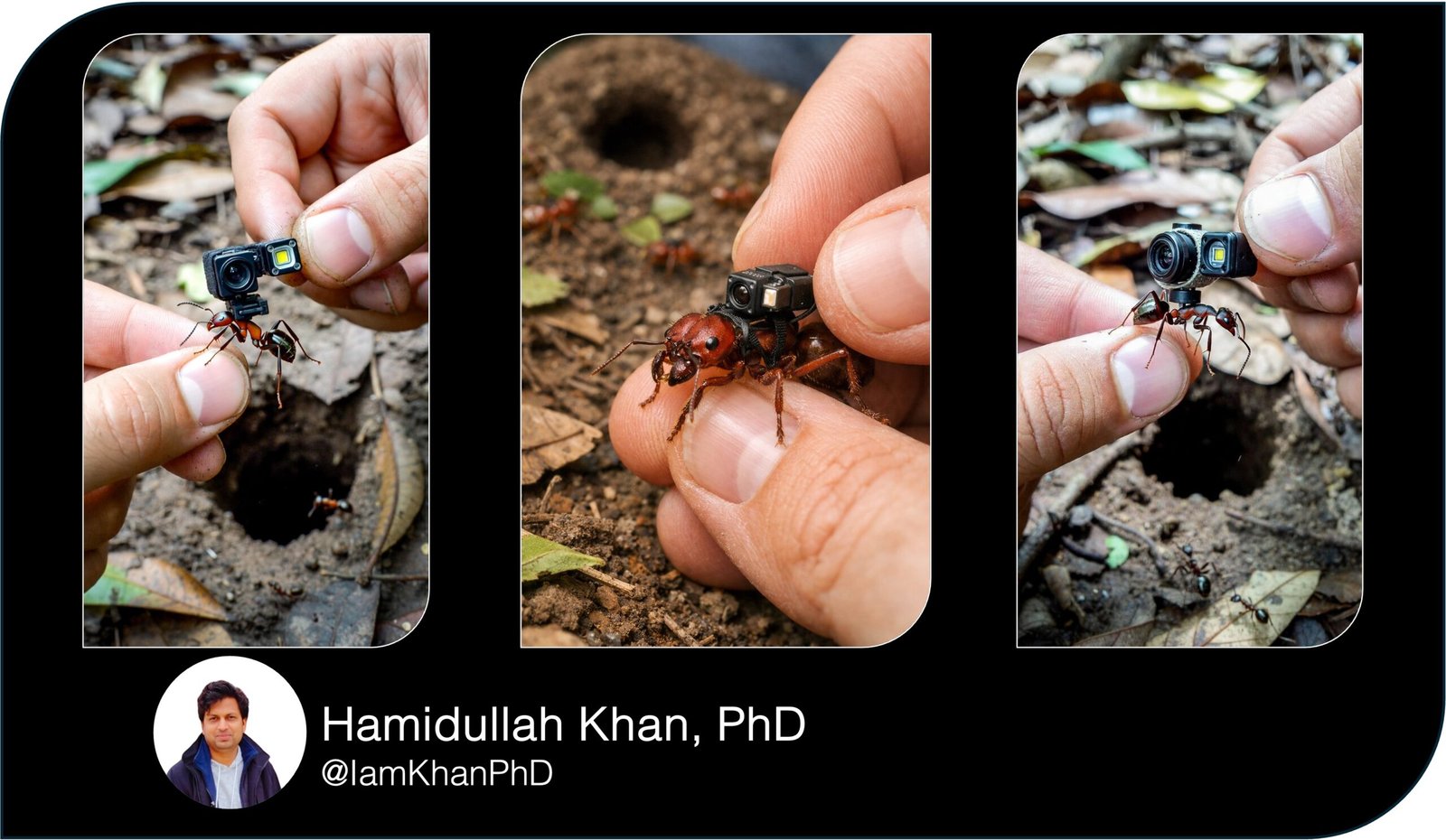
Inside an Ant Colony Using AI Micro-Camera Prompts
What would the world look like from the back of an ant?
Using advanced AI prompting techniques, we can simulate a body-mounted research camera attached to a leafcutter ant as it enters its underground colony. The result looks like raw scientific footage — tight tunnels, thousands of moving ants, egg chambers, and complex subterranean systems.
In this post, I’m sharing the exact prompt system used to generate this ultra-realistic POV footage, including the macro setup shot and the full underground exploration sequence.
These prompts are designed for AI video and image generators and follow strict realism rules so the footage feels like real experimental wildlife documentation, not animation.
If you’re experimenting with AI filmmaking, wildlife simulations, or viral POV content, these prompts are an incredible starting point.
Below you’ll find the complete prompt sequence used to create the ant-mounted camera experience.
Image Prompt 1
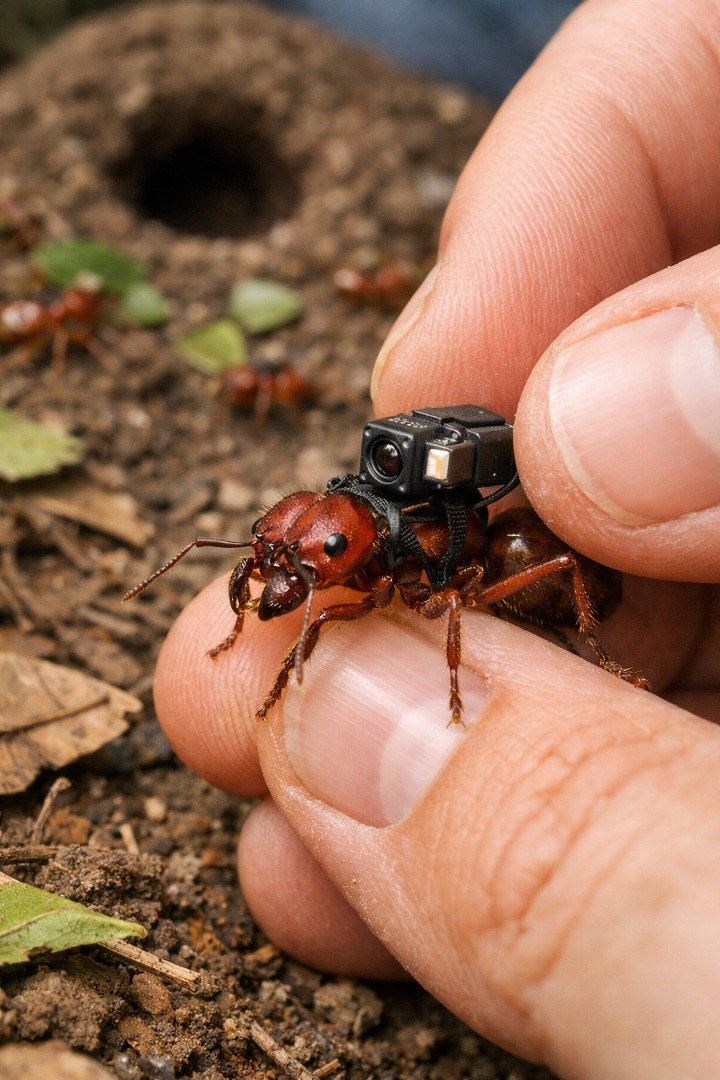
Ultra-realistic macro wildlife photograph, scientific field documentation style, vertical 9:16. Midday natural daylight in a tropical forest floor setting with leaf litter, small twigs, damp soil clumps, and a clearly defined leafcutter ant nest entrance nearby (a round soil opening with a low mound and scattered cut-leaf fragments). A human researcher is seated on the ground close to the entrance. One hand gently holds a single leafcutter ant (Atta cephalotes) between thumb and index finger with careful, non-injurious pressure; the ant is alive and alert, legs slightly flexed. The other hand precisely adjusts a miniature biological research camera mounted on the ant’s upper dorsal thorax using a visible micro-harness: thin, realistic scientific strapping that loops around the thorax and secures a tiny forward-facing lens. The camera appears plausibly small and lightweight at true scale relative to the ant’s body, with a small adjacent LED module visible beside the lens. Fine details: ant’s segmented body, subtle hairs, mandibles, antennae articulation, compound eye texture. The camera mount shows realistic tension points and contact with the exoskeleton without deforming it. Background includes a few worker ants moving naturally near the entrance, carrying small leaf fragments, but the held ant is the clear subject. No underground visuals, no artificial lighting, no stylization—pure macro research photography realism.
Video Motion Prompt 1
Field-recorded scientific research footage, vertical 9:16, 8 seconds, single continuous take, no cuts. Fully body-mounted POV from a micro camera mechanically strapped to the ant’s upper dorsal thorax, lens aligned precisely with the ant’s forward direction. 5–10% of the ant’s body remains visible at the bottom of frame at all times: the top edges of the ant’s head and the base of the antennae occasionally entering frame bottom as it shifts. Start on the forest floor in natural daylight with leaf litter and the nest entrance ahead. The sequence begins immediately after camera adjustment: the ant is placed on the ground facing the viewer’s direction consistent with the prior image setup. The frame holds perfectly still for a brief moment (true stillness—no stabilization drift, only subtle ambient micro tremor from placement settling). Then the ant performs a clearly readable turn: head turn first (antennae sweep), then thorax rotates, then the entire body aligns—the frame rotates only because the ant turns, with a slightly jerky, stepwise rotation matching tiny foot placements. Once aligned toward the burrow entrance, the ant begins forward locomotion; the POV shows rhythmic micro-vibration from footsteps and slight bobbing from body mechanics. As the ant approaches the entrance, the hole enlarges in frame; the ant lowers its body naturally and enters head-first. Surface brightness rapidly diminishes as soil walls occlude daylight. The LED remains off until surface light disappears, then activates automatically only once the view is fully inside the hole, producing a tight, harsh beam with rapid falloff into darkness. The LED never shines outward toward open air after entry. Audio only: tiny footsteps on grit, faint leaf litter scraping, slight soil contact sounds—no music, no narration.
Video Motion Prompt 2
Direct continuation, vertical 9:16, 8 seconds, uncut. Fully mounted ant-thorax POV with 5–10% of ant anatomy visible at bottom edge: antenna bases and occasional mandible tips flicker into view. The ant moves deeper through a tight soil tunnel barely wider than the ant, walls close to the lens. Illumination strictly from the camera-adjacent LED, creating a narrow cone that reveals granular soil texture, compacted clumps, root fibers, and moist patches that reflect harshly. Outside the beam: near-total darkness. The frame motion is entirely driven by the ant’s gait—rapid micro-bobbing, vibration, and slight lateral sway as legs negotiate uneven floor. The tunnel ceiling occasionally brushes near the lens area, producing brief occlusion shadows and tiny shakes. Fine micro-particles fall and drift through the LED beam after contact with the ceiling. A colony member passes in close proximity from the side—brief body contact causes a small jolt and a scrape sound; the passing ant’s legs and cuticle flash through the beam. No stabilization smoothing, no cinematic movement—raw body-mounted realism with confined geometry and continuous forward progress.
Video Motion Prompt 3
Continuous, vertical 9:16, 8 seconds, no break. The tunnel gradually opens into a major colony chamber with multiple branching paths visible at the periphery of the LED beam. The ant’s posture changes the camera angle naturally—slight lift then dip—causing the frame to tilt only as the ant climbs a small soil lip into the chamber. The LED beam sweeps only as the ant’s head and body reorient; no independent scanning. The chamber is densely populated: hundreds of leafcutter ants moving in organized traffic lanes, some carrying fresh cut leaf fragments, others transporting soil pellets or organic debris. The ground shows distinct zones: compacted “road” areas, looser soil margins, and moist soil regions that reflect sharply under the LED. Visible biological complexity: clusters of worker groups coordinating movement, ants pausing to antennate and exchange chemical cues, steady flow along intersecting tunnel mouths. In the beam’s mid-ground, egg clusters and larval groups appear in protected recesses guarded by workers; pale brood contrasts with dark soil but fades rapidly into darkness beyond the LED’s falloff. Audio is purely micro-sound: many tiny footsteps, soft scratching, occasional collisions, faint rustling of carried leaf fragments.
Video Motion Prompt 4
Direct continuation, vertical 9:16, 8 seconds, uncut. The ant approaches a brood-focused area along the chamber edge. The camera lowers as the ant naturally dips its head and thorax, bringing the LED beam closer to the ground and increasing glare on moist soil grains. Egg clusters become prominent—small, pale, tightly grouped ovals—surrounded by larvae that subtly flex and twitch. Worker ants actively tend brood: mandibles gently reposition eggs, antennae tap larvae, and workers form a protective moving ring. The ant’s footsteps cause continuous vibration; the frame occasionally nudges soil ridges. A minor collision occurs when the ant bumps another worker—a sharp jolt shifts the frame briefly, followed by a quick recovery driven by the ant’s legs. The LED reveals fine particulate dust suspended momentarily after the bump. Depth behind the brood area collapses into darkness; only the immediate LED cone is visible, with harsh, realistic falloff. No stylized blur, no exaggerated depth effects—just true macro sensor limitations and tight illumination.
Video Motion Prompt 5
Continuous, vertical 9:16, 8 seconds, single take, no cuts. The ant moves from the brood edge into a central colony zone with broader space and dome-like soil structures formed into rounded mounds and reinforced walls. Heavy traffic activity fills the frame wherever the LED reaches: dense lines of workers streaming in multiple directions, occasional larger workers pushing through. Food reserves appear as organized piles: cut leaf fragments, partially processed plant material, and organic debris zones. The LED beam “scans” only as the ant turns its head and body—small rotations produce correspondingly small frame rotations; larger turns cause readable frame swings with stepwise foot placement. The ant pauses briefly—the frame becomes completely still except for minute body tremor—then resumes forward motion into a darker recess, where the LED harshness becomes more pronounced against damp soil. Subtle wall contact causes short bursts of vibration and scratching sounds. Audio remains strictly natural: layered tiny footsteps, soil friction, brief collisions, organic movement—no music, no narration, no dialogue.


About author







Add comment