
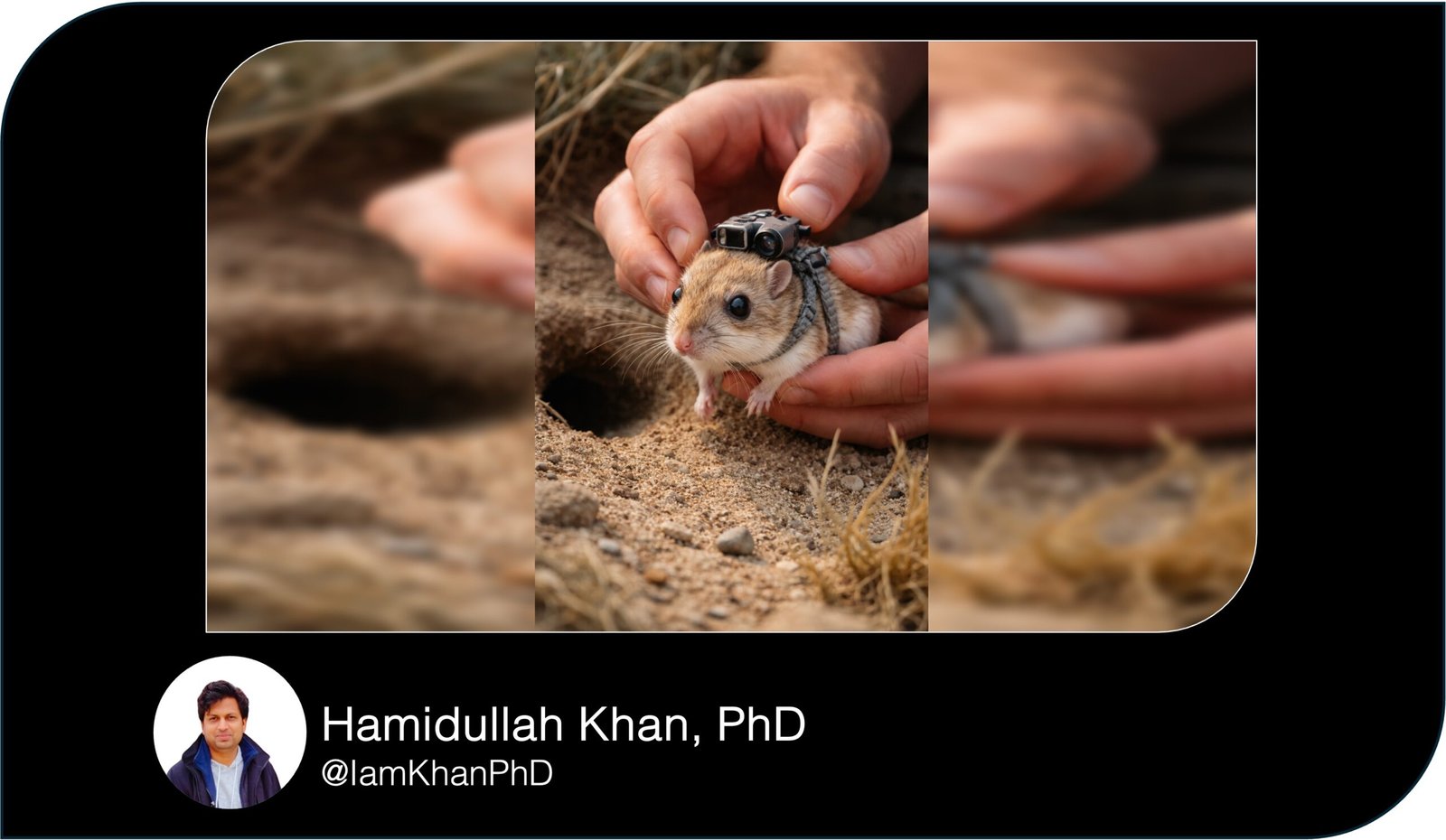
Create Viral AI Videos for FREE Using Grok
Viral AI videos are everywhere on YouTube, Instagram, and TikTok — and many of them are getting millions of views.
The surprising part?
Most of them are created using simple AI tools and a few prompts.
In this tutorial, you’ll learn how to create the same type of viral AI videos using Grok. We’ll start by generating a single image and then convert it into an animated video using AI prompts.
The best part — you can do it completely free.
Image Prompt
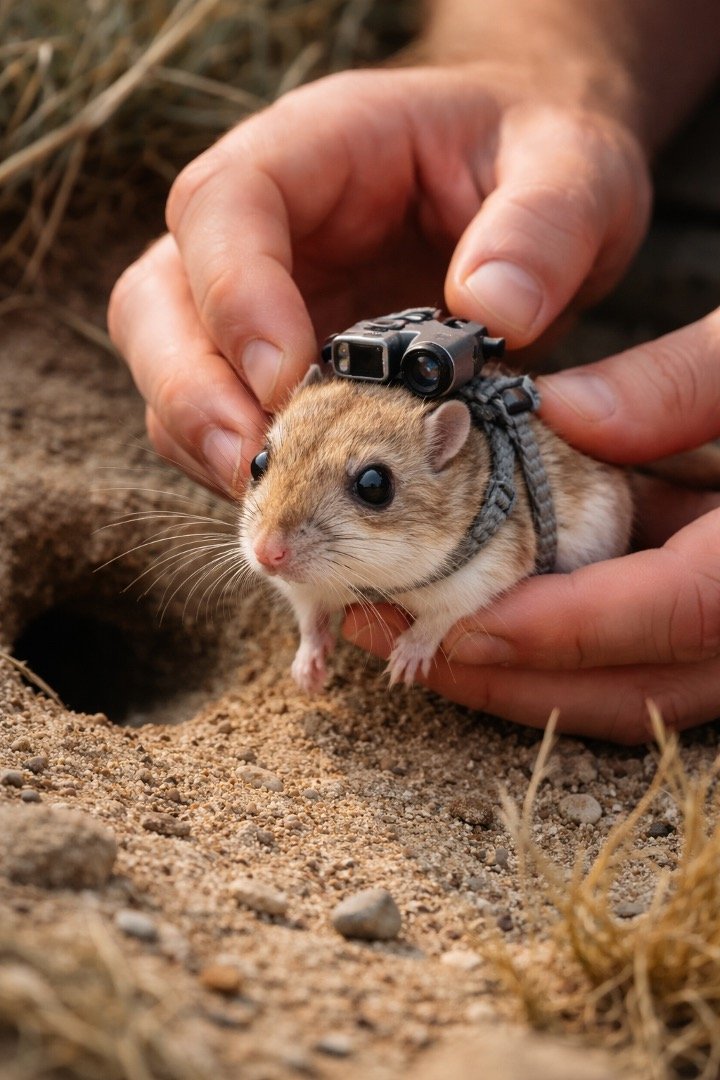
Ultra-realistic, field-science macro wildlife photograph captured outdoors in a real desert scrub environment at ground level, natural daylight only. A human researcher is seated on sandy soil beside a fresh kangaroo rat burrow entrance in a sparse desert habitat (low shrubs, scattered pebbles, dry grasses, compacted sand, small seed husks). The kangaroo rat (Dipodomys spp.) is gently held between the researcher’s fingers with careful, non-harmful restraint: thumb and forefinger supporting the upper torso while allowing the animal to breathe and keep its head free. The animal’s scale is accurate: small-bodied rodent with large eyes, long whiskers, prominent ears, and visible cheek pouches; fine fur texture and dust particles on the coat are sharply resolved. In the researcher’s other hand, they adjust a tiny biological research camera rig mounted on the kangaroo rat’s upper dorsal back (between shoulder blades). The rig is physically realistic and miniature: a micro action-camera module no larger than a large coin, with a compact rectangular housing, a small forward-facing lens, and a separate tiny LED research light mounted immediately beside the lens. A visible micro-harness wraps around the animal’s chest and torso with thin scientific strapping (fabric-like bands and micro buckles), snug but not compressing, with a small dorsal plate where the camera is mechanically secured. The harness and strapping are clearly visible and believable, with stitching, tension points, and contact with fur. The camera lens is aligned precisely with the animal’s forward-facing direction, not angled off-axis. The researcher’s fingers are shown making a final alignment adjustment on the camera mount, checking strap tension and lens orientation. The scene must look like authentic scientific wildlife documentation: no stylized color grading, no cinematic lighting, no exaggerated depth blur—just crisp macro clarity, realistic shadows, and accurate desert tones. The burrow entrance is visible nearby as a dark circular opening in sand, with disturbed soil and tiny footprints around it.
Video Motion Prompt 1
Vertical 9:16, raw field-recorded scientific footage from a camera mechanically mounted to the kangaroo rat’s upper dorsal back using a clearly visible micro-harness; 5–10% of the animal remains visible at the bottom edge of frame at all times (tips of ears, fur ridge at shoulders, whisker bases occasionally bobbing into view depending on posture). The scene begins on the desert surface in natural daylight: the researcher’s hands finish a small adjustment to the camera and LED unit; the lens remains forward-aligned with the animal’s head direction. The researcher then places the kangaroo rat on the sandy ground facing the viewer, matching the orientation implied by the photo setup: the frame is stable for a brief moment as the animal holds still—no stabilization smoothing, the image is completely motionless except for tiny breathing micro-movements. Then the animal turns: first a clearly readable head turn toward the burrow entrance, followed by the body pivot. The camera frame rotates only because the animal rotates—head turn → shoulders shift → full body alignment → full frame rotation. The kangaroo rat begins moving forward in short, quick steps toward the burrow opening; the mounted camera shows subtle rhythmic vibration from footfalls and small sand impacts. The burrow entrance grows larger in the center of frame as the animal approaches. At the edge of the hole, the kangaroo rat lowers its body and enters head-first—never backing in. The frame dips naturally with the body posture; the lens points forward into the hole, never outward toward the surface once entry begins. As the animal crosses the threshold, surface light rapidly collapses into darkness. Only after the surface light disappears completely does the compact LED beside the lens activate automatically, producing a tight beam with uneven falloff: harsh reflections on sand grains close to the lens, rapid darkness outside the beam. No cinematic cuts; one continuous 8-second take. Natural micro-audio only: tiny foot taps on sand, faint strap friction, soft soil contact at the entrance.
Video Motion Prompt 2
Direct continuation, vertical 9:16, fully mounted body-locked POV from the dorsal camera; harness remains implied by rigid camera behavior and the persistent 5–10% body visibility at the bottom edge (fur ridge and ear bases bobbing slightly with movement). The LED is the only light source: tight cone, uneven intensity, bright hotspot near the center with rapid falloff to near-black at the edges. The kangaroo rat moves through a tight sand-and-soil tunnel just wide enough for its body; the walls are close to the lens, textured with compacted sand layers, tiny roots, and granular clumps. As the animal squeezes forward, shoulder and back movement causes the frame to tilt subtly; tunnel contact produces micro-vibrations and occasional brief shakes when the camera housing brushes the wall. Fine dust particles drift and tumble through the LED beam, especially after the animal’s paws kick sand backward; occasional micro-crumbs fall from the ceiling into the light. The camera angle changes only due to the animal’s posture: a short upward push, then a dip as it clears a tighter pinch point. A colony member of the same species briefly passes in the opposite direction in a side squeeze-by moment—fur and whiskers flash through the beam at close range, causing a quick bump that jolts the frame for an instant. The scene is confined, dark, and physically plausible—no ambient glow, no sunlight, no fill. Natural micro-audio only: rapid footfalls, scratching claws, sand friction, brief strap creak from body compression.
Video Motion Prompt 3
No break, vertical 9:16, the tunnel gradually opens into a broader subterranean chamber complex. The mounted POV remains rigidly body-driven, with 5–10% of the kangaroo rat visible at the frame bottom (ear bases and the top of the head/shoulder fur line appearing more clearly as posture rises). The LED beam now reveals a larger, multi-path chamber: branching tunnel mouths, packed soil floor, scattered seed husks, and distinct traffic lanes worn into the substrate. Multiple kangaroo rats move through the chamber in organized patterns—some crossing quickly, some pausing to sniff and pivot, others carrying seeds in their cheek pouches. The chamber is biologically busy: constant small movements, frequent crossings, and visible seed transport activity. Along one chamber edge, there are seed storage zones: clustered piles of seeds and husks in shallow depressions, some partially covered by loose sand as if cached. Moist soil regions appear as darker patches that reflect the LED more sharply, producing specular highlights and uneven glare. The animal’s head movements cause the LED beam to scan left and right only as the body turns—no independent light motion. The camera experiences mild shake whenever the animal steps onto looser sand or brushes past another animal; these impacts create brief, realistic jolts. No sterile emptiness: the environment is dense with activity and interconnected tunnels, with constant motion and subtle dust in the beam. Natural micro-audio only: foot taps on soil, soft squeaks and rustles (no dialogue), scratching and debris shifting.
Video Motion Prompt 4
Vertical 9:16, continuous uncut footage from the dorsal-mounted camera. The kangaroo rat approaches a more protected storage-and-nest-adjacent chamber branching off from the main traffic lane. The body lowers naturally as it moves into a slightly tighter corridor; the frame dips accordingly, and the LED beam compresses into a narrow tunnel view. The ground shows heavier seed accumulation and fine organic debris—tiny plant fibers, husk fragments, and small pellet-like droppings consistent with a lived-in burrow system. The animal pauses briefly; the frame becomes completely still except for faint breathing micro-motions, emphasizing the fixed mount. The LED illuminates a dense cache area: multiple piles of seeds in different sizes and textures, some freshly gathered, some older and dusty. Another kangaroo rat enters the edge of the beam and interacts with the cache—sniffing, shifting seeds, briefly bumping the mounted animal. That contact causes a minor collision jolt: a sharp, single shake and quick recovery, with no stabilization smoothing. Depth fades into darkness beyond the LED hotspot; only the immediate area is visible, with rapid falloff. The animal then resumes movement, turning slightly; the frame rotates only with the body. Natural micro-audio only: seed rattling, soft scraping, brief body contact thump, foot taps.
Video Motion Prompt 5
Vertical 9:16, continuous, uncut research footage from the kangaroo rat’s dorsal-mounted micro-camera with adjacent LED. The animal enters a central colony zone within the burrow system: a larger dome-like chamber with multiple tunnel entrances at different angles, compacted soil walls, and layered sediment textures. The LED beam reveals heavy traffic and coordinated behavior: many kangaroo rats moving through, some pausing at tunnel junctions, others transporting seeds, and several sorting or pushing loose sand to maintain pathways. Food reserves are clearly present in multiple cache pockets around the chamber perimeter—seed piles and husk clusters arranged in shallow alcoves. The mounted camera’s viewpoint is unmistakably body-driven: when the animal lifts its head, the frame tilts upward; when it lowers or crouches, the frame dips; when it turns, the beam sweeps with the body turn only. The animal pauses mid-chamber; the frame becomes fully still, showing the LED hotspot on a busy section of ground where others pass through the beam, casting brief moving shadows. Occasional nearby contacts cause brief vibrations—light bumps, sand shifting underfoot—without any smoothing. The environment remains fully underground: absolute darkness beyond the LED cone, no ambient fill, no sunlight. Natural micro-audio only: continuous foot patter, soil friction, seed movement clicks, faint rustles, minor collisions, organic movement sounds.

About author









Add comment